
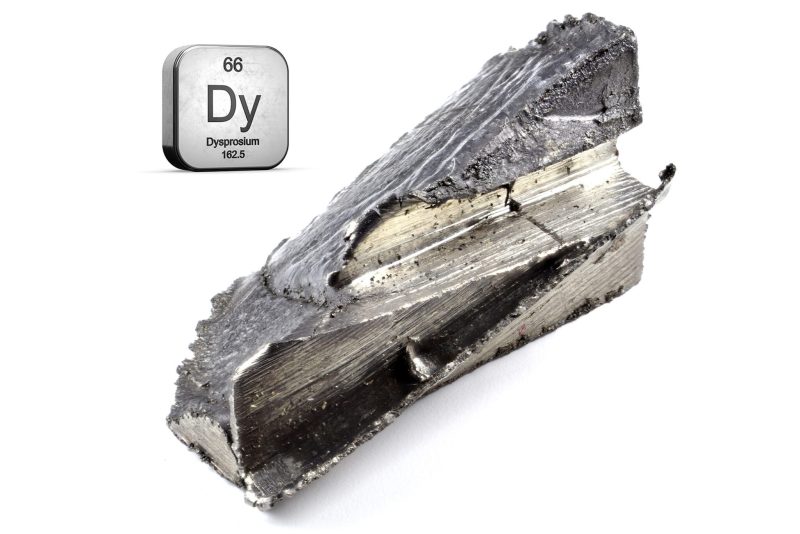
From 4 April 2025, China started the rare earth export control policy. Seven kinds of medium and heavy rare earths are on the list. See details search <Announcement No.18 of 2025 of The Ministry of Commerce and The General Administration of Customs of The People’s Republic of China Announcing the decision to implement export control on some medium and heavy rare earth related items>
I. Samarium related items (Samarium cobalt permanent magnet materials)
II. Gadolinium related items
III. Terbium related items(Terbium-containing NdFeB permanent magnet materials)
V. Lutetium related items
IV. Dysprosium related items(Dysprosium-containing NdFeB permanent magnet materials)
VI. Scandium related items
VII. Yttrium related items
In the rare earth permanent magnet field, Samarium cobalt permanent magnet materials is full controlled, and high grade NdFeB permanent magnets are because of Terbium-containing or Dysprosium-containing also under control.
It is obvious that China strictly controls high-performance rare earth permanent magnet products. So what roles Dysprosium and Terbium are in rare earth permanent magnets. Can high-performance NdFeB permanent magnets be manufactured without dysprosium and terbium?
Dysprosium and terbium can significantly enhance the coercivity of NdFeB magnets, which is the ability to resist demagnetization, enabling the magnets to remain stable in high-temperature environments and prevent demagnetization.
How many Dysprosium and Terbium in rare earth permanent magnets
In the NDFEB magnet formula, In the formula of neodymium iron boron, there are approximately 65% iron, 32% rare earth, 1% boron, and about 2% other elements. The total content of rare earths should not exceed 30-32%. For every 1% dysprosium replacing neodymium can increase the intrinsic coercive force by 3-4 kOe, For every 1% terbium replacing neodymium can increase by approximately 7-8 kOe.
But dysprosium in the formula it will decrease the Br(remanence). And the price of Dy is about 1800RMB/kg, Tb is about 8500RMB/kg. Higher-grade NDFEB magnets require the formula of dysprosium, while the top-grade magnets must have terbium added.
Magnets without Dysprosium and Terbium
It takes at least two to three months to apply for an export license for magnets now. There is still the possibility of being rejected. Therefore, the magnetic materials factory began to develop high-performance NdFeB permanent magnets without dysprosium and terbium. For now, the below grade can be made without Dysprosium and Terbium.
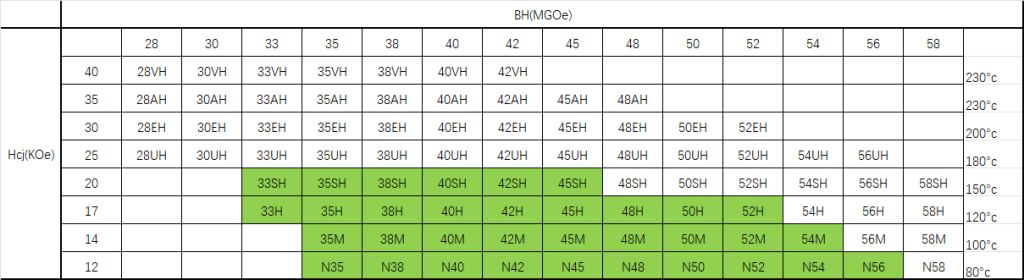
Grade SH from 33SH to 45SH.
Grade H from 33H to 52H
Grade M from 35M to 54M
Grade N from N35 to N56
Although these grades of magnets do not require an export license, they still need a third-party composition certificate. The testing cost is also very high. If it is just a sample or the order quantity is small, the testing cost accounts for a very high proportion. The inspection charge is about 300 USD per item. Therefore, we suggest that customers purchase a sufficient quantity of magnets at one time.