
How to Determine the Magnetic Flux Consistency of Permanent Magnets.
Determining the “magnetic flux consistency” (also known as “flux uniformity” or “homogeneity”) of permanent magnets is a key indicator for assessing the performance and quality of a batch of magnets or a magnet array. It refers to whether the magnetic flux output between different permanent magnet units, or at different positions of the same magnet, is consistent.
The following is a systematic approach, steps, and considerations for determining the magnetic flux consistency of permanent magnets.
I. Core Assessment Parameters
Typically, two core parameters are focused on:
- Surface Magnetic Flux Density (Gauss or Tesla): Using a gaussmeter to measure the magnetic induction intensity at a specific point on the magnet’s surface (usually the center or a specified point). Consistency requires the measured values at this point for all magnets to be within a very small tolerance range
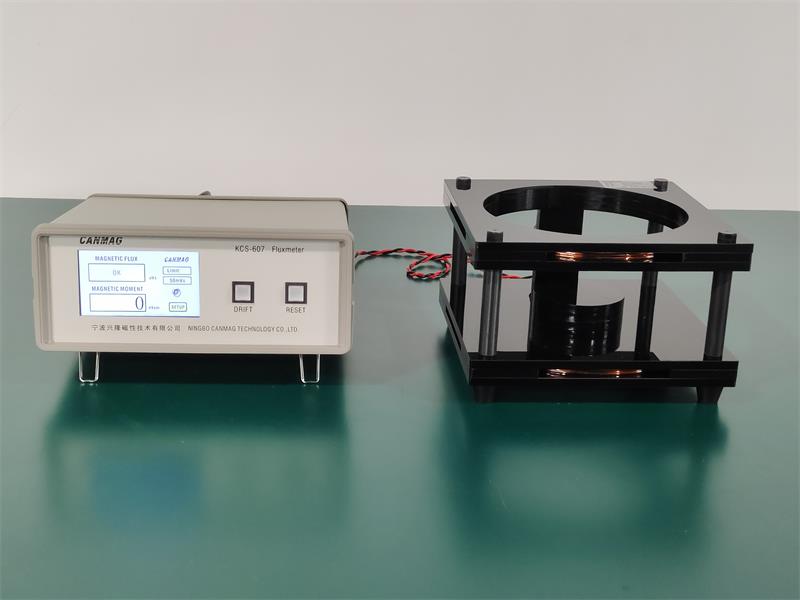
- Magnetic Flux (Maxwell or Weber): Using a fluxmeter and a Helmholtz coil to measure the total magnetic flux of the magnet. This is a more comprehensive and accurate indicator because it reflects the sum of the magnetic performance of the entire magnet, not just the field strength at a single point.
II. Common Determination Methods and Steps
Method A: For a Single Magnet (Checking Self-Uniformity)
Determination: The magnet is considered acceptable if the non-uniformity is less than a specified threshold (e.g., <5% or even <2% for high-performance applications).
Tools: High-precision teslameter (gaussmeter), 3D moving fixture or scanning stage.
Steps:
Define a grid on the magnet surface.
Place the probe perpendicular to the magnet surface and measure the magnetic flux density at the center of each grid point.
Record all data and calculate:
Average value (μ)
Maximum and Minimum values
Standard Deviation (σ)
Non-Uniformity: (Max - Min) / Average × 100% or Standard Deviation / Average × 100%
Method B: For Batch Magnets (Checking Consistency Between Magnets) – More Common
1. Tools
Fluxmeter + Measuring Coil (Most Standard and Recommended Method):
- Use a dedicated coil (e.g., Helmholtz coil) of fixed size and shape. Insert the magnet into the center of the coil in the same orientation, position, and speed each time.
- The fluxmeter reads the peak magnetic flux (Φ) generated as the magnet passes through the coil.
Gaussmeter (As a Quick Sorting Tool):
Use a fixed fixture to position the gaussmeter probe at a fixed point (e.g., 1mm) from a specific location on the magnet surface for measurement.
2. Standard Measurement Procedure (Critical!)
Constant Temperature: All measurements must be performed in a constant temperature environment (e.g., 23±1°C) as magnetic properties are temperature sensitive.
Stable Magnet Condition: Magnets must be fully magnetized and adequately aged (e.g., stored for over 24 hours) to eliminate post-magnetization instability.
Standardized Operation:
- For each measurement, the relative position and orientation of the magnet to the probe or coil must be absolutely identical.
- The use of positioning fixtures is crucial.
- For the fluxmeter method, the speed and trajectory of the magnet through the coil must be consistent.
Equipment Calibration: All measuring instruments require regular calibration.
3. Data Processing and Determination:
Measure all magnets in a sample batch (e.g., 1000 pieces)
Plot a data histogram or process control chart.
Calculate the mean (μ) and standard deviation (σ) for the entire batch.
Common determination criteria include:
- Tolerance Range Method: Specify that the flux value must be within ±X% of the nominal value (e.g., ±3%).
- Sigma (σ) Method: Require the standard deviation σ to be below a certain value, or specify that the “μ ± 3σ” range must fall within an acceptable tolerance band. This is a stricter statistical process control method.
- Binning: Sort magnets into different performance grades (e.g., Grade A, Grade B) based on measurement results. Magnets within the same grade are considered consistent. Customers can purchase specific grades as needed.